

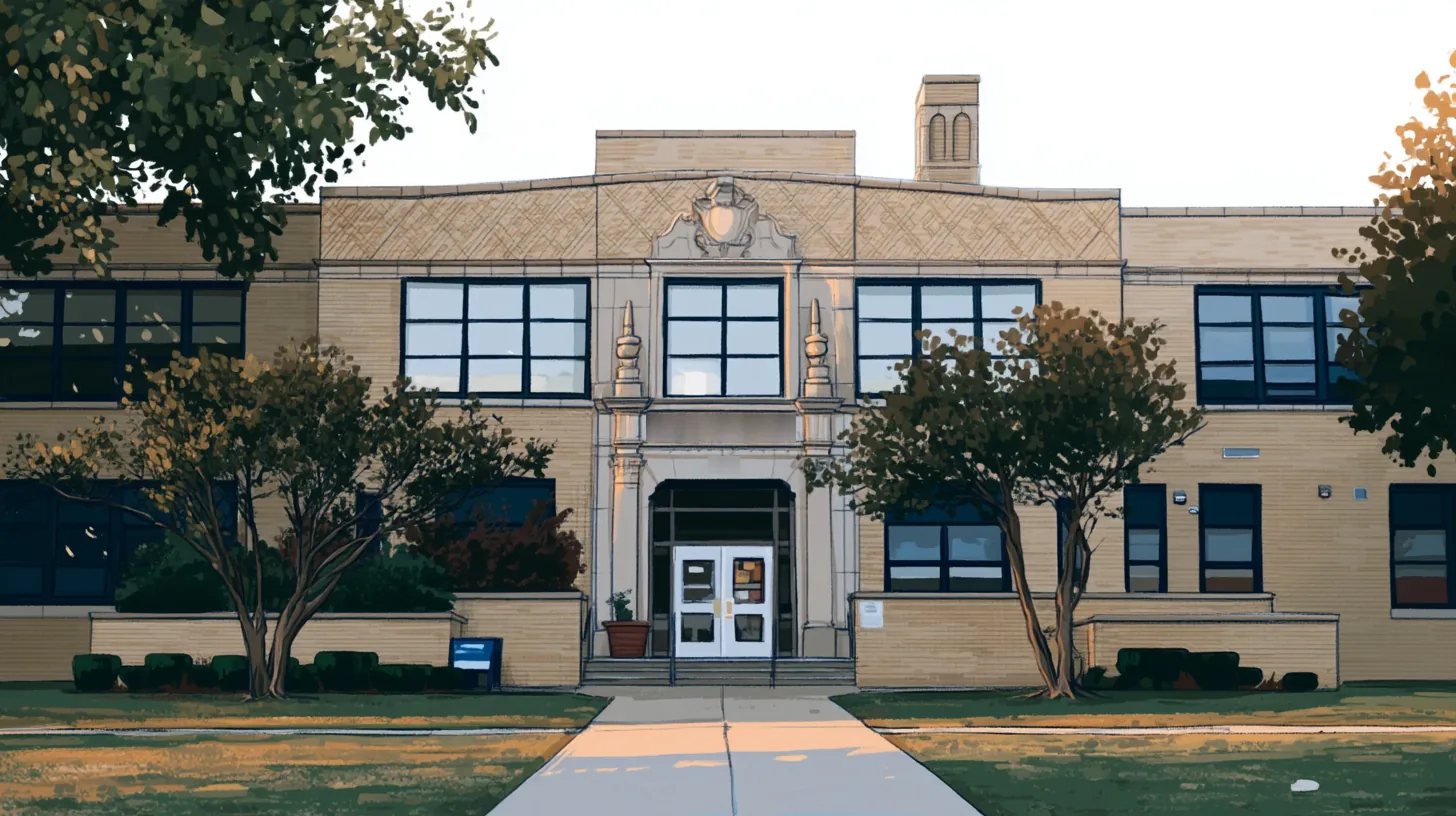
On November 19, 2026, the Dallas Independent School District Board of Trustees voted 6–3 to approve Dallas ISD school closures at six campuses—four in South Dallas and Oak Cliff, and two north of Interstate 30—as the district faces a projected $128 million shortfall. The vote comes amid a wider enrollment decline across North Texas, as families turn to charter schools, private academies, and homeschooling. With a Democratic governor-elect taking office in January, parents now face both campus reassignments and new uncertainty in Austin.
When do the closures take effect? The Dallas ISD board recap of November 20 says the six campuses will close for the 2027–2028 school year. Dallas Free Press and KERA report that five of the campuses are slated to close at the end of the school year, and that Arlington Park Early Childhood Center closed earlier this year.
Dallas ISD School Closures: Which Schools Are Closing and How the Board Voted
The six campuses are:
- Arlington Park Early Childhood Center, Arlington Park / Medical District
- Ignacio Zaragoza Elementary School, Old East Dallas
- Joseph J. (J.J.) Rhoads Learning Center, South Dallas; receiving campus H.S. Thompson Elementary
- N.W. Harllee Early Childhood Center, East Oak Cliff / Tenth Street Historic District
- Harrell Budd Elementary School, Oak Cliff
- Boude Storey Middle School, South Oak Cliff / Cedar Crest
Four sit south of the Trinity River; the other two sit north of Interstate 30.
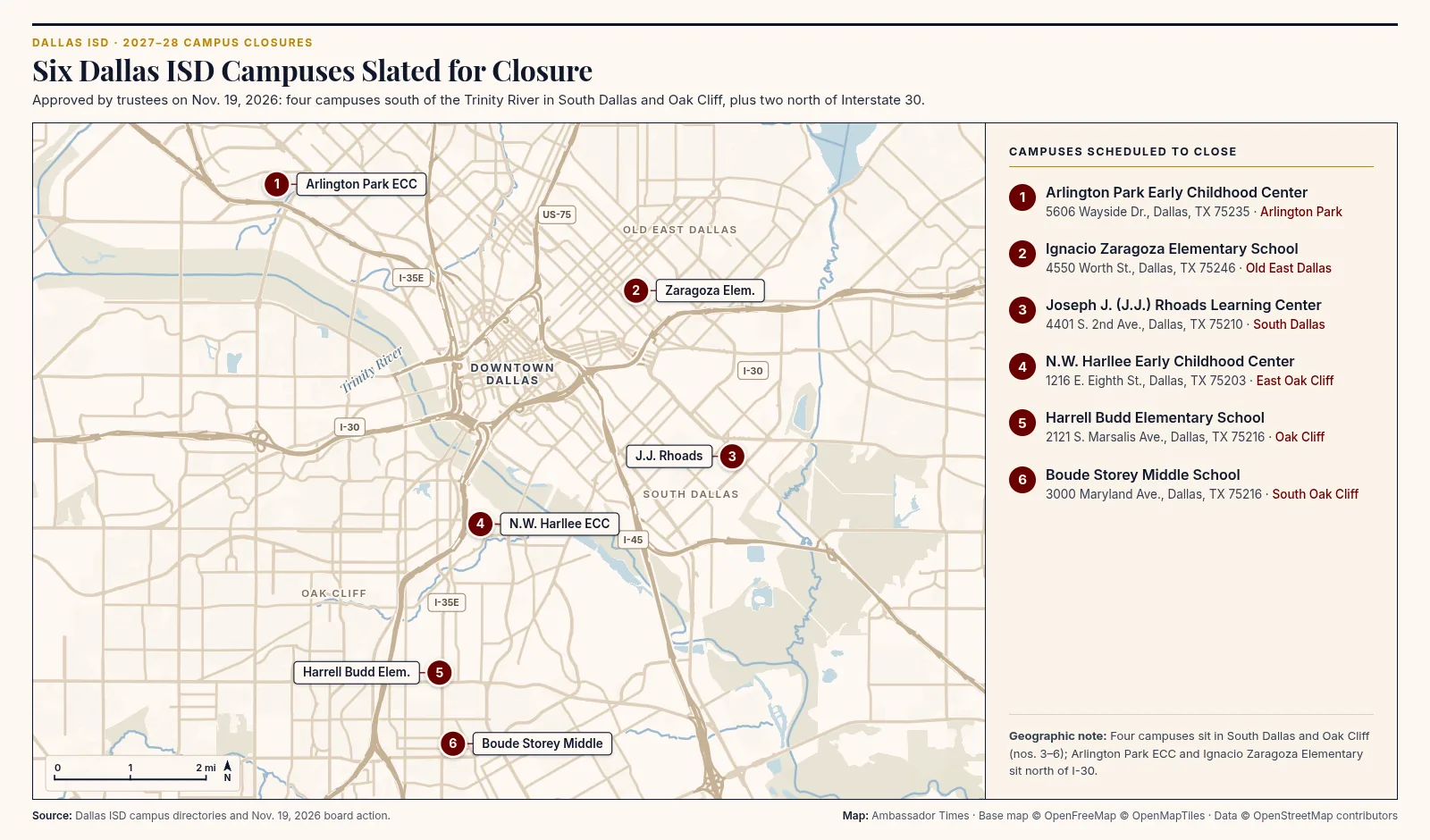
Six Dallas ISD campuses are listed for closure for the 2027–28 school year following the board's Nov. 19, 2026 vote, according to the district; Dallas Free Press and KERA report that Arlington Park Early Childhood Center closed earlier this year. Four sit south of the Trinity River in South Dallas and Oak Cliff, while Ignacio Zaragoza Elementary and Arlington Park Early Childhood Center sit north of Interstate 30. Source: Dallas ISD · Base map © OpenFreeMap © OpenMapTiles · Data © OpenStreetMap contributors · Map: Ambassador Times
District officials cited falling enrollment, inflation, and reduced state funding. Fall enrollment came in roughly 3,100 students below projections and pushed the shortfall to about $128 million, according to district staff. After weeks of public comment, the board remained divided. Trustee Dan Micciche told NBC 5 that trustees had to find the least painful ways to close the gap, while Trustees Byron Sanders, Joyce Foreman, and Ed Turner opposed closing Rhoads and failed to separate or delay the vote.
Officials said Rhoads students can move about a mile and a half to H.S. Thompson Elementary with the same teachers, and that Resource Center South will remain open at the Rhoads campus. Dallas ISD said other reassignments will weigh feeder patterns, distance, and academic opportunities.
Why Enrollment Is Falling Across North Texas
The Dallas vote is part of a wider contraction. On November 13, The Dallas Morning News and NBC 5 reported that nine of ten major North Texas districts lost enrollment this fall, and that McKinney ISD was the only one to grow. Statewide, preliminary Texas Education Agency figures show roughly 135,000 fewer students in Texas public schools this fall, a 2.5 percent drop and the largest single-year decline on record, according to the Texas Tribune.
Dallas ISD had largely deferred a closure wave already underway around it. Since 2023, boards in Richardson, Plano, Irving, Carrollton-Farmers Branch, Lewisville, Grapevine-Colleyville, and Arlington have voted to close or consolidate campuses, and Fort Worth’s 18-campus plan, approved 8–0 in May 2025, is the largest, with closures scheduled through 2029. The Texas Observer reported in June 2026 that about 45 North Texas schools had been closed or approved for closure since late 2023, the most of any Texas region.
Many families are leaving traditional neighborhood schools for other options. State-authorized charter schools now enroll 446,633 students, about 8.2 percent of Texas public enrollment, according to the Texas Education Agency. The Texas Home School Coalition estimates that more than 750,000 Texas students are educated at home, and private Christian academies continue to draw families as well.
Texas Education Freedom Accounts, launched this fall, explain only part of the shift. State figures reported by the Texas Tribune show 111,327 students funded this year, and only about 17 percent of them had attended a Texas public school the year before.
What Austin’s Shift Means for Education Freedom Accounts
Families looking beyond the district must also weigh a political turn in Austin. On November 3, Gina Hinojosa defeated Governor Greg Abbott, and Democrats won the Texas House, while Republicans kept the Senate. The Legislature convenes on January 12, 2027, and Governor Abbott remains in office until Hinojosa’s inauguration on January 19. Asked whether she would veto future account funding, Hinojosa declined to commit, calling the next six months “one big negotiation.”
Lawmakers have already filed repeal bills, including Senate Bill 106, Senate Bill 294, and House Bill 164. A separate proposal, House Joint Resolution 47, would go the other way by limiting state regulation of private and home schools. Comptroller-elect Sarah Eckhardt takes over the program on January 12 and has promised an audit.
This year’s accounts remain funded, with a final installment due February 1. Application dates for 2027–28 have not been published, and any repeal would need both a Democratic House and a Republican Senate. Many middle-income families fall outside the program’s priority tiers.
The Ambassador Times View: Why Families Are Stepping Away
Public officials often treat enrollment loss as a matter of birth rates and funding formulas. Those forces are real, and it is not fair to blame teachers or trustees for hard arithmetic when campuses sit under-enrolled. Many Dallas ISD teachers labor faithfully, and parents are right to grieve when a familiar school is disrupted.
Yet the numbers do not tell the whole story. Education is never morally neutral, and many parents are stepping away because they no longer trust a large system to form their children well. In conservative Christian conviction, parents—not the state—hold the primary responsibility for their children’s minds, habits, and character.
That conviction is why many households are turning to homeschooling co-ops and hybrid models. Readers can consult our earlier reporting on hybrid homeschooling in Dallas and our comparison of top hybrid homeschools in Dallas.
A Question of Trust
Dallas ISD has framed these closures as a budget problem, and the arithmetic is real.
But the shortfall follows the enrollment, and the enrollment follows parents. Across North Texas, families are making a difficult and often costly choice to move to another district, pay private tuition, or teach at home, because they no longer trust the public system to serve their children well. No consolidation plan can restore that trust, and until districts reckon with why parents are leaving, the closures are unlikely to stop at six.